
Or, “Work and leisure can join once again!”
At the recommendation of a dear friend (and super blogger), I just read the wonderful “How to be Idle” by Tim Hodgkinson, editor of the likewise themed journal The Idler. The book is ordered by every hour in the day, beginning with the celebration of taking as long as possible to get out of bed, then into a productive yet relaxed afternoon and ending with nighttime revery and meditative reflection. It's a layout of the day that encourages thoughtfulness rather than busy work, and is a model of being that emphasizes relationships and personal contentment over anything else. It is clear to me that I have found a kindred spirit and a valuable alternative posing of many of my own principles - why shouldn't those be the most cherished and important aspects of our lives?
His argument, is that we, as all the little guys in this industrial & consumer society, need to turn our backs on this system that is so clearly failing us and “be responsible for ourselves; we need to create our own republics… A world where everyone is free to create their own life, their own work, their own money.” Quit your job. Live your life. Define your own currencies. You will get far more accomplished this way.
Exactly!
While he does at one point say that we should avoid domestic work, I’ll let that slide. The power of domestic work is that it functions precisely as it’s own form of economy. There is no dollar value to be placed on lessons which enhance our own faculty, as such knowledge facilitates learning not only how to use tools or one’s hands, but how to apply that sense of ability – capability - to any other activity. Teach a man to fish, you know?
These are the lessons that are lost without this precious time, which are surely part of Hodgkinson’s notion of the idle life. These are times for quiet pondering, spaces to problem-solve, to sort through the day. The greatest barrier preventing everyone from enjoying and taking full advantage of these moments is, of course, the work day, and more often than not the high-stress-too-long-and-dreadful work day. Our current definition of “work” is itself a huge part of the problem, or at least a major chunk of the mental block preventing us from delineating between so-called productive activity that is burdensome and actually productive activities that will bring us joy, both during and after. Of course gardening (for example) is work, very hard work, physically and mentally. However, the fruits of one’s labor (literally) and even the process of handling earth and engaging in the critical analysis needed for successful growth are incredibly joyful tasks, engaging the mind, activating the body, and resulting in a little pocket of pretty green – a perfect setting for, of course, doing nothing. If a fruit, vegetable, or herb garden is grown then the benefits will certainly extend past the time it took to sow the seeds, and the plot of land so manipulated and cared for as an operation of joyful work will extend into the realm of the most serious and productive purpose, to feed and care for ourselves and others.
It is a shame then that this term “work” should be so marred by the overwhelming negative implication of wrenching oneself out of bed, out of the home, out of comfort, and into a foreign place in which the individual must abandon all personal pleasure or desired activity and submit to a mode of work which, in most cases at least, is not to their preference or liking. After a full day of demands upon one’s mental energy for such non-useful work, or that which is not useful for the worker, it is certainly understandable that we would end each day feeling drained and numb, not wanting to ask anything of our brains more complex than microwaving something out of a box and turning on the television. In this unnatural and impersonal definition of work, labor of any kind becomes a thing to avoid at all costs, thus disabling our will to execute the very tasks we dreamed about doing all day.
And this is where the notion of different economies may enter the picture.
Time is money, there is no avoiding this fact (though Hodgkinson disagrees). What should be re-examined however is how we define our currencies. As the artist Faith Wilding so eloquently proclaims in her fabulous essay Monstrous Domesticity (1995), 'I am for an economics of care', a broader definition of work and labor in which the value of an action or product is measured according to its functional use by an individual, another person, or community. It is a call to redefine our places in the world, to reconsider the resonance of our actions and to recognize the abilities we have as individuals. Wilding's essay focuses on a strong interest in domestic craft and work by young people and their absolutely alien relation to it; "Monstrous Domesticity" is a reflection on this contemporary lack of ancient knowledge and the desire to re-incorporate those lessons into our daily lives. She speaks about her college age art students' interest in learning such basic domestics skills as knitting and sewing - traditional women's work - which was never included as part of their expected learned-skill vocabulary. These students, she says, had no means of understanding this type of work from first hand learned experience and therefore could only gain an understanding of it as a nostalgic work-process, their final product taking exaggerated forms.
The desire for domestic knowledge expressed by Wilding's students is the same outcry for a redefinition of our notion of "work". We don't produce for ourselves, and we know - instinctually, perhaps - that there is something very wrong about that. Producing for ourselves is a survival skill, a skill of care. The only economics or currency that can ever truly matter is how much and how well we care for ourselves and each other. Hodgkinson's definition of idleness as self-defined personal freedom is exactly this as well. Giving ourselves the time and liberty to find contentness and being content with the things we have and the things we can produce for ourselves - this is ultimately the only way to lead a satisfied life, a life truly worth living. Isn't that drive then the key to survival?
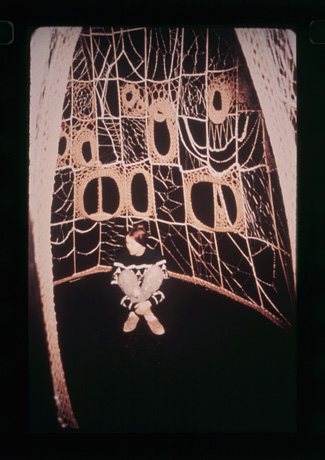
Faith Wlding, Crocheted Environment (Womb Room)
1972 (recreated 1995)


 Posts
Posts


No comments:
Post a Comment