8.18.2009

30 Indias at Once

I spent the month of July traveling in India. A week in Delhi, two in the Himalayas, and then another 5 days back in the city. Even after all that time I am sure I have barely scratched the surface of understanding the country, which even a Delhite described to me as “at least 30 Indias happening at once”.

The Himalayas

A good way to sum up New Delhi in 2009 is a snapshot of a traffic jam: the air is acrid and foggy from the pollution, there is an endless sonic deluge of one million horns blaring at once, no traffic lights, people fill the road selling books or toys or simply begging, and there are bumper to bumper vehicles as far as the eye can see - and most important to note, the definition of “vehicle” includes everything from large busses and cars, to rickshaws, bicycles and mopeds, to oxcarts and elephants, and all of these are simply overflowing with people. Contemporary India is an amazing example of just barely controlled chaos. These different ways of life - industrial and modern to agricultural and feudal - operate like alternate dimensions, inhabiting the same spaces at the same times yet existing in completely different ways.

One of the side trips I took was to Manali, a old town high up in the mountains, next to Rohtang Pass, one of highest mountain passes in the world. However, what was once home to a vibrant and unique local culture and landscape has been taken over by tourism; Here was the 31st dimension of the country, Epcot India.
Places created solely out of the tourist industry are fascinatingly without identity. I actually love train stations and airports for precisely this reason, yet a major part of that adoration is that they are places specifically crafted for the transient. They are designed to make it as difficult as possible to find any semblance of home there, and often any familiarity to be found is simply there to reinforce the feeling of "I have just arrived and am about to be going; I am in an airport". The Epcot effect is a bit different though; Manali felt utterly without identity because of the incessant display of Western recognized symbols of Indian-ness in place of a unique native culture. In fact, aside from hiking excursions - and yes, the mountains were stunning - the only things to do in Manali are to buy poorly made textiles and Hindu icons, and to talk to other tourists. The locals have figured out that selling yak rides and shoddily made Tibetan prayer wheels will make them a decent living; so be it, perhaps in our global age all bets are really off.
The Himalayas, very understandably, have a history of strong ex-pat communities, and Manali and the surrounding Kullu Valley are strong examples. There seem to be a lot of Korean and German owned businesses in Manali, and actually the one good restaurant I found to get a beer is Korean-owned. They carry an Australian craft beer brewer that's opened a brewery in India (American beer entrepreneurs take note, this is a brilliant idea, since imports are so expensive, the getting is very good for the beer business here - according to one article in the Hindustan Times, there are at least 7 foreign breweries looking to set up shop in Himachal Pradesh alone). There's a cafe and pastry shop chain simply called "German Bakery" which for whatever reasons really held my attention - it certainly appeared as a sign of the phenomenon of globalism (that and the whole using a laptop in the Himalayas thing...). Still, this is clearly a tourist economy, banking on the ability to create passible copies of American and European creature comforts, and capitalizing on the romanticism of India in Western eyes.

Still, just outside this circus, the everyday still maintains some character, and it is the smaller marks of culture that tend to stick with me while traveling. The most fascinating differences are found in the mundane. The lunch I had at Naggar castle was a Kullu valley specialty called sidu that was actually just giant pierogi, each one took up half a dinner plate, and very curiously the potatoes and onions inside were spiced with cumin seed, coriander, black pepper, and paprika (the recipe and images linked call for a poppy seed filling, even more curious, and more eastern European). I ate this following our visit to a small museum devoted to the artwork of a Russian family who had settled in the area in the 1800s and who were responsible for significant land preservation work, among of course being philosophers and artists and a laundry list of other things. I can't help but wonder now if there may have been some other kind of Eastern European presence in the area, and if sidu isn't really a product of influence from the (extremely delicious) pierogi, or vice versa!

Food travels with people across borders along with any/all other signatures of a culture. The preparation and eating of food and drink are major acts that pace one's day, that play a part in much social interaction, and which often contain major signfiers of class, of family history, and of course cultural and global economic history (i.e. the tomato was brought to Europe from America). The intimacy of observing and learning from one's cuisine is the experience that may really teach you what "home" means to the people in the place where you are merely a visitor. How people prepare their food and whether it requires a day of laboring in the kitchen or if meals are designed to be purely functional or an instant fix, if utensils are used and which, if vegetarianism or meat eating is stressed, etc. I overheard the enlightening observation that Indian food is so laborious in its preparation that it must either be the product of people who do not have non-domestic work to do (i.e. peasants) or who have servants to do it for them. That logic certainly explains the contemporary American love of "fast food", in the corporate and broad senses, there is a marked appeal for things that are quick and easy and don't require laboring in the kitchen all day.
Indian cuisine is very spicy, oily, and incredibly time consuming if you want to do it just right. In fact it seems like the longer one takes to make something - if it sits in water overnight, then ferments, then dries, then is ground down, then is cooked again with this and that and some other things added and then cooked again for 12 hours (by the way, that's the gist of the halvah I had) - then all the better. Laboring as much as possible seems to be key, even if it's the servants who did the laboring. Work as an expression of care is a formula very much in place here, the extreme pampering of guests is another example to note. It was difficult for me to get used to servants, but that's just another sign of the complexities of Indian society that I'm sure I can only barely wrap my head around now.

One aspect of traveling that I as an American find so fascinating is the deep cultural history that may be told through other cuisines. The US certainly has it's great regional fare, and the ways in which many typical American foods are adaptations of Old World hand-me-downs is fascinating in itself (take a look through foodtimeline.org for more). There is little that more personal than the food one eats, and the recipes handed down through generations can define one's sense of familial connection. There is a perfect beauty in these most basic acts of sharing.

Like most people going to India for the first time, I did get sick. The worst part about it wasn't the stomach trouble, but not being able to taste every single thing and to get some cooking lessons was very upsetting. I was able to squeeze in a bread making session though, and I'm thrilled I did - I now have a new favorite Indian bread, Lacha Paratha, also known as 100 Layered Paratha.
Lacha Paratha is most common in Punjab and in Pakistan, and there seem to be a few variations on the specific technique that makes the bread so special. Paratha is a general term for a fairly standard north Indian flat bread (important to note: North India has wheat as their staple grain, whereas rice is predominant in the south). The dough is made only from whole wheat flour, oil and water, and is prepared by and rolling it out very thin and then frying, making a perfect flat, dense tool for scooping up all the delicious gloppy curries you can eat.
Lacha Paratha is a little more complicated, but well worth the effort. After rolling out the dough, the thin sheet is folded back and over like a fan, then folded in half, wrapped and rolled into a ball, then rolled out flat again. The result is a bread that flakes apart in a spiral, with delicious ghee hiding in every cranny, and making every bite a little different.
I found a couple great videos showing the making of Lacha Paratha using two different folding techniques here and here.
Below is a great recipe with very simple directions, taken from snackorama.blogspot.com. Note that the recipe calls for folding the dough “like saree pleats” - that's my favorite part.

Lacha Paratha:
1 cup whole wheat flour
1 tbsp oil
warm water as needed

Rub oil into the flour and then add warm water as needed and make a stiff dough. Let it rest for an hour.
Make lemon sized balls out of the dough. Take a ball and roll into oval shape. Coat the top side oil and sprinkle flour generously. Now fold it from one side to other side like a saree pleats. Now roll it like a coil and continue to do the same with other balls too.
Now heat a tawa/pan on medium-high heat. Roll each coil shaped ball into a flat chapathi. Fry it on both sides applying little oil. Remove from the pan and put it on a paper towel or kitchen towel and press it from sides such that the flakes will separate.

And, if you're feeling lazy, and if you have a good Indian grocer nearby, maybe you can find these.


Namaste.

2.16.2009

Ispirato

After writing my last post, I was inspired to do a little kitchen craftiness and have whipped up some anise biscotti to bring when I visit my Aunt in New Jersey tomorrow.
Wouldn't Franny be proud.

Recipe adapted from The International Cookie Cookbook by Nancy Baggett

3 Cups all purpose flour
1 1/4 tsp ground star anise*
2 1/2 tsps baking powder
1/8 tsp salt
2/3 Cup unsalted butter, slightly softened (1 stick + 3 Tbs)
1 Cup sugar
3 eggs
3 Tbs orange juice (original recipe calls for zest of 2 lemons + 1/4 tsp lemon juice... we were outta lemons)

Preheat oven to 375 degrees. Mix together the flour, anise, baking powder and salt. In a larger mixing bowl, whisk (or use an electric mixer) the butter and sugar until smooth. Add the eggs and juice (or zest) and whisk/mix until fluffy. Slowly whisk/mix in 1/2 of the dry ingredients, then use a mixing spoon to incorporate the rest. Split dough in half and shape in to two logs about 11 inches long and 2 inches wide on a large greased baking sheet. Bake on the center rack until lightly browned, 25-28 minutes.
Remove from the oven and let cool completely. Using a very sharp knife, slice the biscotti log into 1/2 inch sections. Lay out on the baking sheet and bake for 5-7 minutes on one side, then flip and bake for 4-5 minutes on the other.
Be very careful with this step as it can be tricky to get them to brown evenly. I suggest doing this in two batches to ensure that the oven heat is uniform. And just keep an eye on them.

Now all I need is an espresso with a spot of Ouzo. Delicious.


* original recipe calls for 2 tsps ground anise - actually, while remarkably similar in flavor, they are completely different plants. In general, star anise is twice as flavorful as anise, or anise seed, therefore depending on what you have on hand you should adjust the recipe accordingly. I like an extra kick though.

Read more on the incredibly useful Tips, Tool & Ingredients section of the Bon Appetit site.
Quite interesting.

Franny and Antoinette


This is my little house in South Philadelphia. A little shorter, with fewer trees (a very bizarre south philly phenomenon), and infinitely more familial than what I'm used to back in my native New York.

In complete opposition of over-developed, forever in flux Manhattan, home-grown South Philadelphians OWN South Philly. Each street belongs to a different family, whose roots in the neighborhood often go back to its development in the late 1800s. My next door neighbors, Franny and Antoinette, are a typical example. The rundown goes like this: Franny and Antoinette are sisters, both were born (literally) and raised in their house, which their father moved into around the turn of the last century. They have a cousin and two nieces who live on the block, one of which runs our corner store which has been family-owned and operated for as long as anyone can remember. They have a nephew who lives with his girlfriend down the street a block away. Franny actually lives around the corner now, but since Antoinette's health has gone down hill - she is now housebound - they pretty much live together. My house belonged to their godfather, who lived there till he passed away about 8 years ago. His blood relatives are equally dominant on the street. They are (almost comically) totally classic Italian-American, and have become my surrogate grandmothers, completely stereotypical in their nagging and guilt-tripping, and also in the amazing culinary and domestic traditions they have shared with me.

Whenever Franny sees me coming home tired and hungry from a long day at work, she says something along the lines of "Lauren, you're coming home? This late? It's a sin I tell you, a sin." Then Antoinette will come to the door and say "Lauren, you're working too hard. You're never home. You gotta take care of yourself honey." Then Franny will go into her usual monologue about the little kids on the street being too loud, how they don't listen, how kids today don't know any discipline, etc. etc. Antoinette, who can swear like a sailor if she's in the right mood, will chime in, and inevitably they go into a history of all the people who have come and gone on the street, which ones were the biggest assholes, how much the neighborhood has changed, what it was like in "their time"... meanwhile I'm still standing outside, exhausted, and starving (their speeches seem to go on the longest especially when I'm also carrying a lot of stuff). This can go on for half an hour. Really. Eventually one of them will tell the other to stop and let me go home, which is a cue to the other to bark at the first for being rude, and I'm instead invited in for dinner. Usually it's fresh pasta from a local shop and some kind of sauce that Franny has been laboring over - a fact always emphasized - all day. There's some kind of green and meat too, making for a full dinner. We sit, we eat, and also in classic Italian grandmother style, one meal per sitting is never enough, and of course rejecting food in this situation is taken as an extreme insult. They make me a sandwich, they bring out cookies, miraculously a cake emerges form the fridge, and suddenly I've been at the house for four hours, over the course of which I'll hear their gorgeously intimate and nuanced history of 100 years on McClellan street.

I never got a chance to develop a close relationship to any of my biological grandparents, and have always said that I would love more than anything to have a big Italian family. When I was 12 we took a family trip to Italy to visit my mother's cousin and her Italian husband. On one of our last nights, we attended a big dinner of their neighbors and relatives - I don't remember which guests were which, nor do I think the distinction mattered. At a table of perhaps 15, there were two women in their 90s, a baby, and every age in between; there were four generations in all, each sharing in this moment of each of their lives, all sharing the same food, the same stories, embracing their generational differences and developing even stronger bonds because of them. I remember being incredibly moved by the experience, and left in complete awe of all that this family must be able to share with each other simply by keeping those ties to personal history intact.

Being American implicitly prevents one from having such deep bonds to generational histories, and the - very American - exodus to and from cities only makes those cuts deeper. We scatter, we flee, we are a society born of the mind set that things are going to be better over there. We see our bonds as shackles, and remain obsessed with the pursuit of a new frontier, the romance of a great beyond. We don't know how to connect and be content with the people and things around us, and how can we when we have built so much since abandoning our roots.

Instead, we develop our own families and must fill in the blanks for our own histories. While 100 years of McClellan Street is impressive and a rare treat, I can only imagine what must have come before.

9.26.2008

Fall, in love

Well, summer is gone and we are officially into the throngs of what promises to be a lovely autumn. The leaves are turning their new hues, it’s time to take out the cardigans (yes!) and the drama of Philadelphia’s sunsets has increased tenfold. Let not the close of summer keep us from enjoying excursions, weekending now and then and even going to the beach – my parents went to the Jersey shore last weekend. If you are in the Northeast, this is prime winery time, or at least ripe for taking a drive, walk or bike ride out in the crisp air. Go do it! Everything will be so much better. Last night I took an hour long detour on my way out to dinner just so I could spend time biking in the cool air. Yes, autumn rules. Going out doors is nice. Watch the sunset, forget about your clock, have that cathartic Caspar David Friedrich moment.


When I went up to Hunter New York I sat and watched a sunset with my friends for what felt like an eternity. This was THE moment of my summer, and many things came into perspective just allowing myself to clear my mind and put my focus on the light shifting over the mountains. Yes, it is very corny. I don’t care – sunsets are beautiful. My sister visited some friends in Olympia, Washington in August and came back with her own sunset moment. Apparently, right in the middle of a nice social evening, her friend suddenly shouted out “Quick! We have to go to the coast now or we’ll miss the sunset!” of course this excursion was not a pre-planned part of the day, but nevertheless everyone piled into their cars and zoomed out towards the ocean, with the pure, simple motive of watching the sunset. My sister was very moved by this sudden burst of passion for such a seemingly un-extraordinary event; it was with this moment that it became apparent to my sister that life for her friend in Olympia was precisely about enjoying these moments – the beauty observed in the every-day things is what makes every day enjoyable. It’s classic but true, the west coast just seems more in to standing back and taking in the scenery.

Here is My west coast sunset, seen at Black's Beach in San Diego last March:


And in Hunter, NY:


There is no reason for us not to pursue those instants of secret beauty, to follow and take pleasure in every moment of delight that the simple fact of the world turning offers us. This is life lived to it’s fullest, to take pleasure in the wealth of gorgeous detail all around us. While my weekend in the country was wonderful, I’m finding endless wonders right here at home as well.

Of course taking that trip to Hunter was even better for the friends I was with. I love making things and baking for friends anyway (as I write this I am baking something for my roommate’s gallery reception), so of course I whipped up a little something that we all enjoyed with our breakfast the first morning. This recipe will now always be associated with memories of late summer in the woods, and of all the lovely things I saw there.

Peach Mountain Bread

1-2 Peaches (alas, peach season is over, but maybe you can scrounge up some stragglers)
1/4 Cup sugar
1/4 Cup honey
2 Cups flour
2 tsp baking powder
1 tsp salt
1 tsp powdered ginger
1/2 tsp cinnamon
1/4 tsp nutmeg
1 egg
1 Cup milk
2 TBS melted butter
1/2 cup chopped walnuts

Preheat oven to 350 degrees. Butter a loaf pan.
Slice the peach or peaches into thin wedges, approx. 1/4 – 3/8 inch wide along the peel. Set aside.
In a large bowl mix the flour, sugar, baking powder, salt, ginger, cinnamon, and nutmeg. In a small bowl, whisk the honey, egg, milk and butter until fully mixed. Add the wet to the dry and add the walnuts, stir until “just mixed”.
Pour batter into the loaf pan. Working somewhat quickly, layer the peaches in rows of about four slices so that the corners overlap (see photo – get it? The peaches look like mountains. Cute.). Cover the entire top of the loaf – this is why you might need more than one peach.
Bake for 45 minutes – 1 hour, until a knife inserted in the center comes out clean. Let cool for about 10 minutes, and remove from pan to cool on a rack or ceramic plate. Yum!

9.13.2008

Idle hands

Domestic production is joyful production.

Or, “Work and leisure can join once again!”

At the recommendation of a dear friend (and super blogger), I just read the wonderful “How to be Idle” by Tim Hodgkinson, editor of the likewise themed journal The Idler. The book is ordered by every hour in the day, beginning with the celebration of taking as long as possible to get out of bed, then into a productive yet relaxed afternoon and ending with nighttime revery and meditative reflection. It's a layout of the day that encourages thoughtfulness rather than busy work, and is a model of being that emphasizes relationships and personal contentment over anything else. It is clear to me that I have found a kindred spirit and a valuable alternative posing of many of my own principles - why shouldn't those be the most cherished and important aspects of our lives?

His argument, is that we, as all the little guys in this industrial & consumer society, need to turn our backs on this system that is so clearly failing us and “be responsible for ourselves; we need to create our own republics… A world where everyone is free to create their own life, their own work, their own money.” Quit your job. Live your life. Define your own currencies. You will get far more accomplished this way.

Exactly!

While he does at one point say that we should avoid domestic work, I’ll let that slide. The power of domestic work is that it functions precisely as it’s own form of economy. There is no dollar value to be placed on lessons which enhance our own faculty, as such knowledge facilitates learning not only how to use tools or one’s hands, but how to apply that sense of ability – capability - to any other activity. Teach a man to fish, you know?

These are the lessons that are lost without this precious time, which are surely part of Hodgkinson’s notion of the idle life. These are times for quiet pondering, spaces to problem-solve, to sort through the day. The greatest barrier preventing everyone from enjoying and taking full advantage of these moments is, of course, the work day, and more often than not the high-stress-too-long-and-dreadful work day. Our current definition of “work” is itself a huge part of the problem, or at least a major chunk of the mental block preventing us from delineating between so-called productive activity that is burdensome and actually productive activities that will bring us joy, both during and after. Of course gardening (for example) is work, very hard work, physically and mentally. However, the fruits of one’s labor (literally) and even the process of handling earth and engaging in the critical analysis needed for successful growth are incredibly joyful tasks, engaging the mind, activating the body, and resulting in a little pocket of pretty green – a perfect setting for, of course, doing nothing. If a fruit, vegetable, or herb garden is grown then the benefits will certainly extend past the time it took to sow the seeds, and the plot of land so manipulated and cared for as an operation of joyful work will extend into the realm of the most serious and productive purpose, to feed and care for ourselves and others.

It is a shame then that this term “work” should be so marred by the overwhelming negative implication of wrenching oneself out of bed, out of the home, out of comfort, and into a foreign place in which the individual must abandon all personal pleasure or desired activity and submit to a mode of work which, in most cases at least, is not to their preference or liking. After a full day of demands upon one’s mental energy for such non-useful work, or that which is not useful for the worker, it is certainly understandable that we would end each day feeling drained and numb, not wanting to ask anything of our brains more complex than microwaving something out of a box and turning on the television. In this unnatural and impersonal definition of work, labor of any kind becomes a thing to avoid at all costs, thus disabling our will to execute the very tasks we dreamed about doing all day.

And this is where the notion of different economies may enter the picture.

Time is money, there is no avoiding this fact (though Hodgkinson disagrees). What should be re-examined however is how we define our currencies. As the artist Faith Wilding so eloquently proclaims in her fabulous essay Monstrous Domesticity (1995), 'I am for an economics of care', a broader definition of work and labor in which the value of an action or product is measured according to its functional use by an individual, another person, or community. It is a call to redefine our places in the world, to reconsider the resonance of our actions and to recognize the abilities we have as individuals. Wilding's essay focuses on a strong interest in domestic craft and work by young people and their absolutely alien relation to it; "Monstrous Domesticity" is a reflection on this contemporary lack of ancient knowledge and the desire to re-incorporate those lessons into our daily lives. She speaks about her college age art students' interest in learning such basic domestics skills as knitting and sewing - traditional women's work - which was never included as part of their expected learned-skill vocabulary. These students, she says, had no means of understanding this type of work from first hand learned experience and therefore could only gain an understanding of it as a nostalgic work-process, their final product taking exaggerated forms.

The desire for domestic knowledge expressed by Wilding's students is the same outcry for a redefinition of our notion of "work". We don't produce for ourselves, and we know - instinctually, perhaps - that there is something very wrong about that. Producing for ourselves is a survival skill, a skill of care. The only economics or currency that can ever truly matter is how much and how well we care for ourselves and each other. Hodgkinson's definition of idleness as self-defined personal freedom is exactly this as well. Giving ourselves the time and liberty to find contentness and being content with the things we have and the things we can produce for ourselves - this is ultimately the only way to lead a satisfied life, a life truly worth living. Isn't that drive then the key to survival?


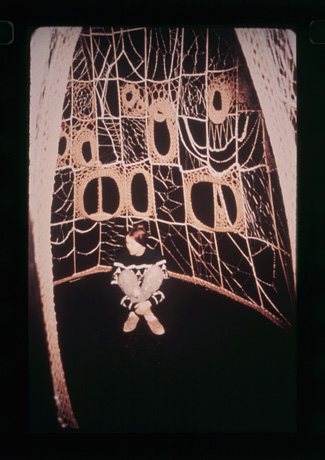
Faith Wlding, Crocheted Environment (Womb Room)
1972 (recreated 1995)

9.08.2008

Native Philadelphia

This is all that’s left of my heartfelt attempt at a lovely lavender-filled window box for the bathroom.


A sad, dried up rotten corpse.

The one to blame? This damn palm tree grass thing that sprouted up a few weeks ago. Fine. If it insists on being the greenest grass, I'll just let it be.
Whatever.
So I went out to the sidewalk and pulled up all the weeds sprouting from every little crack and stuck them in the dirt right next to that guy. Hello “Native Garden”! Now you all have to share. Deal with it. I wanna see who wins.
Hey, if you can’t beat ‘em, you still don’t have to join them. Just mess with them a bit.


The thing is, weeds really are just native plants. These are the flora growing all around us whether we want them there or not. As evident below, North Philly apparently caught on to this a while ago.


It’s our manicured gardens that really have a tinge of absurdity to them, not that I’ve got anything against the obscenely unnatural (link). Gardens are the perfect little refuges from urbanity, precisely planned and kept to serve as our individual ideal syntheses of nature’s most extreme examples of aesthetic beauty. Gaston Bachelard in his fabulous book Species of Spaces muses on his experience of his own garden as tool for observing and interacting with the world outside of the human, the realms of flora and fauna; the garden space exists as a sort of neither/nor site, never fully controlled or controllable by humans (weeds and parasites being the perfect examples for this) yet also far from being wilderness.

I am envious of my neighbor two doors down who has been cultivating a mini jungle of grape vines behind her plot on our block of tightly squeezed together row houses. They reach to the roof of her house and cling over the chicken wire ceiling that hovers above the backyard. The growth is so dense they form a vine cave, making it appear as though she’s actually grown an extension onto her house, not a bad idea now that I think of it. It is the ultimate urban retreat, ahiding behind our typical almost tree-less little South Philly street.

I think my moss is intimidated.

9.02.2008

Moss, mostly

Inspired by the ever wonderful Martha Stewart (who shall be henceforth, in this post and in all future, be referred to simply as Martha) and the special feature on her TV show last May, I have started a Moss Wall. Martha’s bit was about growing moss intentionally in various places in the garden and using it purely as plant accessory. The New York Times, of course, soon followed suit with their own fabulous full-page story on moss gardens, coincidentally, focusing on moss in eastern Pennsylvania.
Lovely.

When I lived in Brooklyn I had a stone patio in place of a backyard; now that I live in South Philly, the great wasteland of cheese steaks, sidewalk lawn chairs and cracked cement as far as the eye can see, I’ve kind the same deal here. The beauty of moss? It’ll grow anywhere, and many kinds love rock or pavement. The idea clicked, and I am now trying to cover my grey back “yard” into a moss jungle.

There are two methods of getting moss to grow where you want it. First, take some already growing clumps of native moss (you can find this on sidewalks, parks, empty lots, wherever) and hot glue them on to a rock or cement surface of your choice. Really. It looks like your pavement has the moss chicken pox for a while, but the moss will begin to spread itself over a couple weeks. The second method also involves beginning with native moss, and then, well, getting it drunk. The basic principal is pretty simple: moss likes to do it, and giving it a couple of beers totally makes it happen.

Mix in a blender on high speed: 2 cups of moss + 1 cup of water + 1 can of beer (I used Yuengling, keep it local, you know) + 1 tsp of sugar. Martha used Miracle grow in place of sugar, but I'd rather not go anywhere near that stuff. The yeast in the beer acts as a fertilizer and because it is live it encourages growth, thus arousing all the spores making reproduction seem like a good idea (should I just go ahead and call this my Shag Carpet?). This mixture will be nice and gloppy, about the consistency of pancake batter, and should look opaque in the blender. Then pick your rock or patio or wall spot and simply paint on! Remember Chia Pets? Same idea, just think of your wall as a really, really big terracotta sheep.

I’m starting my moss wall using both methods, gluing on clumps and then painting over and around them on all three walls (not the wall of the house, don’t mess with that). I waited for a day after a heavy storm so moss I collected would be full and the wall would have a bit of residual dampness to it. I glued on about twelve small clumps, none larger than my palm, around the wall underneath and near the slight lip at the top. Then I painted my mixture on the upper third of the back wall, allowing for any drips or irregularities. Moss likes damp and shade, so I’m giving it a light spray with the hose everyday.

You probably have some moss growing in your backyard somewhere, so you should certainly start with trying to encourage that to grow and spread more. Using moss from your neighborhood is definitely preferable as the spores for those species are already in the air. Also, look for moss growing on similar rock or pavement as that which you are trying to grow on.

There are loads of other moss spreading mixtures, buttermilk or yogurt come up just as often. Unfortunately, this method does not allow for your moss to be straight edge and vegan, if that’s your thing, but hey if you find another alternative let me know! Maybe soy yogurt?

I’ve included some great links at the bottom, many of which have other moss + culture mixtures. Good luck! Have fun.

The Artistic Garden
Oregon State Botany dept. site
Heavy Petal: Moss Graffiti!
that last one is totally my favorite.


grow little green ones, grow!